
Lithium Battery vs Solar Battery: What’s the Difference?
When researching solar energy storage, you may come across terms such as lithium battery, solar battery, LiFePO4 battery, and solar energy storage battery. This can make it difficult to understand whether they are actually different products.
The important point is that “lithium battery” describes the battery technology, while “solar battery” describes how the battery is used.
A lithium battery can be a solar battery when it is designed and configured for storing energy generated by a solar system.
In this guide, we explain the difference between a lithium battery vs solar battery, how they work with solar systems, and what you should consider before choosing one for your home or business.
What Is a Lithium Battery?
A lithium battery is a rechargeable battery that uses lithium-based chemistry to store electrical energy.
For solar energy storage, one of the commonly used chemistries is Lithium Iron Phosphate (LiFePO4).
Lithium batteries are available in different:
- Voltages
- Capacities
- Physical sizes
- Configurations
- BMS designs
- Communication systems
- Energy-storage capacities
Depending on the model, lithium batteries can be used in residential, commercial and larger energy-storage applications.
What Is a Solar Battery?
A solar battery is a general term for a battery used to store electricity generated by a solar energy system.
It does not necessarily describe the battery chemistry.
A solar battery could use:
- Lithium-ion technology
- LiFePO4 technology
- Lead-acid technology
- Other battery technologies designed for energy storage
The purpose is the same: store energy so it can be used when solar generation is unavailable or insufficient.
For example, solar energy generated during the day can be stored in a battery and used later in the evening.
Lithium Battery vs Solar Battery: The Simple Difference
The easiest way to understand the difference is:
Lithium Battery = Battery Technology
Solar Battery = Battery Application
Therefore, saying “lithium battery or solar battery” is not always an either/or comparison.
A LiFePO4 lithium battery can also be a solar battery if it is designed for solar energy storage.
Lithium Battery vs Solar Battery Comparison
| Feature | Lithium Battery | Solar Battery |
|---|---|---|
| Meaning | Describes battery technology | Describes battery application |
| Chemistry | Lithium-based chemistry | Can use different chemistries |
| Solar use | Can be used for solar | Specifically intended for energy storage |
| LiFePO4 | Common option | Can be used as solar storage |
| Capacity | Depends on model | Depends on system requirement |
| BMS | Common in modern lithium systems | Depends on battery technology |
| Application | Solar, backup, storage and other uses | Primarily energy storage |
| Inverter compatibility | Must be checked | Must be checked |
Is Every Lithium Battery a Solar Battery?
No.
Not every lithium battery is automatically suitable for a solar system.
A battery needs to be compatible with the intended application and equipment.
For a solar installation, check:
- Battery voltage
- Energy capacity
- Charge current
- Discharge current
- BMS
- Communication protocol
- Inverter compatibility
- Operating temperature
- Manufacturer specifications
This is particularly important when installing lithium batteries with hybrid or off-grid solar inverters.
Is Every Solar Battery a Lithium Battery?
No.
The term solar battery refers to its application rather than its chemistry.
Traditional solar systems have also used lead-acid battery technologies.
However, lithium-based energy storage has become an important option for modern solar systems because of characteristics such as high usable capacity, long cycle life and low maintenance requirements.
Why Are Lithium Batteries Popular for Solar Systems?
1. High Usable Capacity
The advertised battery capacity is not always equal to the energy you should plan to use.
When comparing batteries, consider:
Nominal Capacity → Usable Capacity → Depth of Discharge → System Efficiency
This gives you a more realistic understanding of how much energy the battery can provide.
2. Long Cycle Life
Solar batteries may be charged and discharged frequently.
A battery designed for repeated cycling can therefore be particularly useful in solar energy-storage applications.
The actual cycle life depends on the battery model, operating conditions, charge/discharge rate and manufacturer’s specifications.
3. Low Maintenance
Modern lithium battery systems generally require less routine maintenance than traditional lead-acid systems.
This can make lithium storage attractive for residential and commercial solar installations.
4. Compact Energy Storage
Lithium batteries can provide substantial energy storage in relatively compact systems.
This can be useful for homes and businesses where installation space is limited.
5. Battery Management System
Many modern lithium batteries include a Battery Management System (BMS).
The BMS helps monitor and manage battery operation, including functions such as voltage, temperature and protection parameters.
However, BMS features differ between manufacturers and models, so always check the specific product specifications.
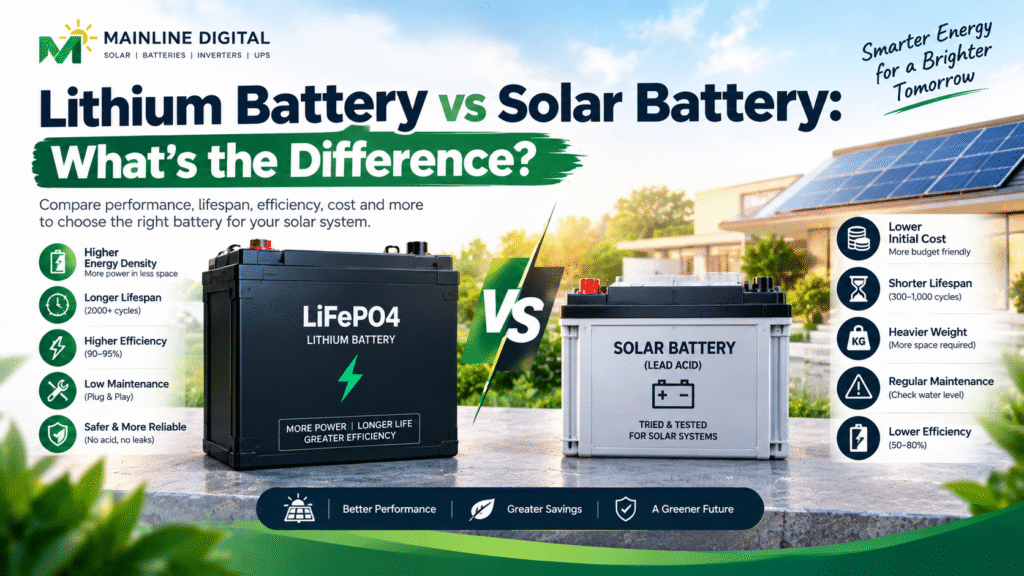
Lithium Battery vs Lead-Acid Solar Battery
Sometimes the actual comparison behind the search for “lithium battery vs solar battery” is lithium vs traditional lead-acid solar batteries.
In this situation, the comparison looks different.
| Factor | LiFePO4 Lithium | Lead Acid |
|---|---|---|
| Cycle life | Generally higher | Generally lower |
| Maintenance | Low | Higher |
| Weight | Lighter | Heavier |
| Usable capacity | Generally higher | Generally lower |
| Initial cost | Usually higher | Usually lower |
| Frequent cycling | Well suited | Less ideal for many applications |
| BMS | Common | Not typically equivalent |
| Space | More compact | Usually larger |
For a detailed comparison, read our guide:
LiFePO4 vs Lead Acid Battery: Which Is Better for Solar?
How Does a Lithium Solar Battery Work?
A typical solar energy-storage system works like this:
Solar Panels → Solar Inverter → Home/Business Loads
When battery storage is included:
Solar Panels → Inverter → Battery → Loads
During the day, solar panels generate electricity. Depending on the system configuration, the energy can be used by appliances, exported to the grid, or stored in the battery.
Later, stored energy can be used when solar generation decreases.
This allows a solar battery to provide energy storage beyond the hours when the solar panels are producing electricity.
How Many kWh of Lithium Battery Do You Need?
The correct battery capacity depends on your energy requirements.
A basic calculation is:
Battery Energy Required = Backup Load × Backup Hours
For example:
If your backup load is:
2 kW
And you need:
5 hours
Then:
2 kW × 5 hours = 10 kWh
This is a basic energy calculation. Actual battery sizing should also consider inverter efficiency, usable capacity, battery operating limits and the specific system configuration.
For more information, read:
How Many kWh of Battery Storage Does Your Home Need?
Lithium Battery for Home Solar Systems
For residential solar systems, lithium batteries can be used to store energy for later consumption.
Depending on the battery size, homeowners may use stored energy for:
- Lights
- Fans
- Refrigerators
- Wi-Fi
- TVs
- Computers
- Security systems
- Selected kitchen appliances
- Other essential loads
Larger systems may be designed to support higher loads, subject to the inverter and battery specifications.
Mainline Digital offers residential energy-storage options including Luminey, LIVOLTEK and other lithium battery solutions.
Explore the lithium battery range available through Mainline Digital.
Lithium Battery for Commercial Solar Systems
Businesses can also use battery storage to support their energy requirements.
Commercial applications may include:
- Offices
- Retail stores
- Clinics
- Restaurants
- Schools
- Commercial buildings
- Industrial facilities
Commercial systems often require more detailed load analysis because energy consumption and peak loads can be considerably higher than residential applications.
Battery capacity, inverter power, discharge capability and future expansion should all be considered during system design.
Lithium Battery Compatibility With Solar Inverters
A common mistake is purchasing a battery first and checking the inverter later.
Instead, confirm compatibility before purchasing.
Important specifications include:
Battery Voltage
The battery voltage must be compatible with the inverter’s battery input requirements.
Charge & Discharge Current
The inverter and battery must operate within their respective current limits.
Communication
Some battery-inverter combinations require communication through protocols such as CAN or RS485.
BMS Compatibility
The inverter may need to communicate correctly with the battery’s BMS.
Manufacturer Support
Always check the manufacturer’s compatibility information for the exact battery and inverter models.
You can explore solar inverters from Mainline Digital when planning a complete solar energy-storage system.
Lithium Battery Price vs Solar Battery Price
Another common misunderstanding is that “solar battery” automatically means a particular price category.
Battery pricing depends on several factors, including:
- Battery chemistry
- Capacity
- Brand
- Cell quality
- BMS
- Cycle-life rating
- Inverter compatibility
- Warranty
- Installation
- System size
For example, a 5 kWh battery and a 15 kWh battery obviously serve different energy-storage requirements.
For a detailed pricing guide, read:
Lithium Battery Price in Pakistan: What Determines the Cost?
Which Is Better: Lithium Battery or Solar Battery?
The question needs to be reframed slightly.
Lithium battery and solar battery are not necessarily competing technologies.
A better question is:
Which battery technology is best for my solar energy-storage system?
If you’re considering lithium storage, a LiFePO4 battery may be a strong option for applications requiring regular cycling, low maintenance and long-term energy storage.
But the final choice should depend on:
- Your solar system size
- Electricity consumption
- Backup requirements
- Required kWh
- Inverter
- Budget
- Installation environment
- Future expansion
Best Lithium Battery for Solar in Lahore
If you’re looking for the best lithium battery in Lahore, don’t select a battery based solely on brand or price.
First determine your energy requirements.
Mainline Digital offers lithium battery solutions from brands including:
- Luminey
- LIVOLTEK
- MENRED
- HWOO
- Sunwoda
You can explore Luminey Batteries, LIVOLTEK lithium batteries and MENRED ESS to compare available solutions.
Frequently Asked Questions
Is a lithium battery the same as a solar battery?
No. Lithium describes the battery technology, while solar battery describes its application for storing energy from a solar system. A lithium battery can be used as a solar battery.
Are LiFePO4 batteries good for solar?
Yes. LiFePO4 is a commonly used lithium chemistry for energy-storage applications and can be suitable for solar systems requiring regular cycling.
Can I use a lithium battery with my existing solar inverter?
It depends on the inverter and battery. Voltage, current limits, communication and BMS compatibility should be checked before installation.
What is the difference between a lithium battery and a lead-acid solar battery?
Lithium and lead-acid are different battery technologies. Lithium batteries generally offer longer cycle life, lower maintenance and higher usable capacity, while lead-acid batteries can have a lower initial purchase cost.
How long does a lithium solar battery last?
Battery lifespan varies by model and operating conditions. Cycle life, depth of discharge, temperature, charge/discharge rate and maintenance all affect actual service life.
Can lithium batteries be used without solar panels?
Yes, depending on the system design. A lithium battery can be used for different energy-storage and backup applications, although a “solar battery” specifically refers to its use within a solar energy-storage system.