
If you are planning a solar system with battery backup, one of the most important questions is:
How many kWh of battery storage does my home need?
Choosing the right battery size is important because a battery that is too small may not provide enough backup, while a battery that is unnecessarily large can increase your overall system cost.
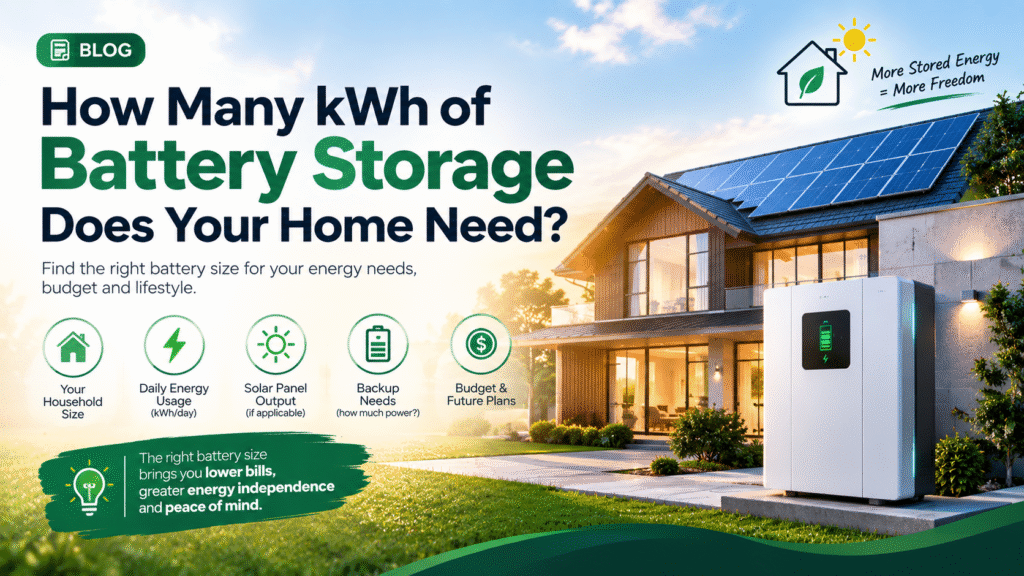
Your ideal home battery storage kWh requirement depends on several factors, including:
- Your daily electricity consumption
- The appliances you want to run during backup
- Required backup duration
- Solar system size
- Inverter capacity
- Battery usable capacity
- Depth of discharge
- Your budget
Mainline Digital provides solar, inverter and energy-storage solutions for residential, commercial and industrial applications. You can explore the company’s Lithium Batteries and Solar Inverters categories.
What Does kWh Mean in Battery Storage?
kWh stands for kilowatt-hour.
It is a measurement of how much energy a battery can store.
For example:
- 5 kWh battery → approximately 5 kWh of stored energy under its rated conditions
- 10 kWh battery → approximately 10 kWh
- 15 kWh battery → approximately 15 kWh
- 20 kWh battery → approximately 20 kWh
However, the actual energy available to your appliances can be different from the battery’s nominal capacity because of factors such as usable capacity, depth of discharge and system losses.
This is why simply choosing a battery based on its advertised kWh isn’t enough.
How to Calculate Your Home Battery Storage kWh
A simple starting point is:
Required Battery Capacity = Backup Load × Backup Hours
For example, suppose your essential backup load is:
2 kW
and you want:
5 hours of backup
Then:
2 kW × 5 hours = 10 kWh
So, approximately 10 kWh of energy would be required before accounting for system losses and other design factors.
In a real solar installation, the battery should be sized with additional factors in mind.
Step 1: Calculate Your Backup Load
You don’t necessarily need to run your entire house from the battery.
Start by identifying the appliances you want to operate during a power outage.
For example:
| Appliance | Approx. Load |
|---|---|
| LED Lights | 200 W |
| Fans | 300 W |
| Refrigerator | 200 W |
| Wi-Fi Router | 20 W |
| TV | 100 W |
| CCTV | 50 W |
| Computer | 150 W |
| Total | 1,020 W |
This example gives an approximate backup load of:
1.02 kW
Actual appliance consumption varies, so appliance ratings or measured consumption should be used for proper system design.
Step 2: Decide How Many Hours of Backup You Need
The next question is:
How long do you want your battery to run your essential appliances?
For example:
2 hours
1.02 kW × 2 hours = 2.04 kWh
4 hours
1.02 kW × 4 hours = 4.08 kWh
6 hours
1.02 kW × 6 hours = 6.12 kWh
8 hours
1.02 kW × 8 hours = 8.16 kWh
This shows why backup duration is one of the biggest factors affecting your required battery size.
5 kWh vs 10 kWh vs 15 kWh Battery
Let’s look at a simple comparison.
| Battery Size | Suitable For* |
|---|---|
| 5 kWh | Essential lights, fans, Wi-Fi, TV and selected loads |
| 10 kWh | Larger essential-load backup and longer runtime |
| 15 kWh | Larger homes or higher backup requirements |
| 20 kWh+ | High-consumption homes or extended backup |
*Actual suitability depends on load, inverter, usable battery capacity and required backup duration.
Mainline Digital’s current lithium battery range includes different capacities designed for different applications.
For example, the Atrix-10 10 kWh battery provides a larger storage option for residential and commercial applications.
The Atrix-15 15 kWh battery is designed for applications requiring greater energy storage.
You can also explore the complete Luminey Batteries range.
Do You Need 5 kWh or 10 kWh Battery Storage?
This is one of the most common questions homeowners ask.
The answer depends on your actual backup load.
Suppose your essential appliances consume approximately 1.5 kW.
If you need 4 hours of backup:
1.5 kW × 4 hours = 6 kWh
In this situation, a battery around 6 kWh or greater may be considered, depending on usable capacity and system losses.
If you want 8 hours:
1.5 kW × 8 hours = 12 kWh
Now a larger battery may be more appropriate.
This demonstrates why battery sizing should be based on load + time, rather than simply choosing a popular battery size.
What Is Usable Battery Capacity?
A battery’s advertised capacity is not always equal to the amount of energy that should be considered available for your loads.
Factors such as:
- Depth of discharge
- Battery management settings
- Inverter efficiency
- Temperature
- Battery condition
- Manufacturer specifications
can affect usable energy.
For example, if a battery has a nominal capacity of 10 kWh, you should check the manufacturer’s specified usable energy before calculating actual backup time.
This is particularly important when comparing different lithium battery brands.
Why Depth of Discharge Matters
Depth of Discharge (DoD) describes how much of the battery’s stored energy is used.
A battery with a higher recommended usable percentage can provide more usable energy from the same nominal capacity.
For example, two batteries may both be advertised as 10 kWh, but their usable energy may differ according to their specifications.
Therefore, when comparing:
10 kWh Battery A vs 10 kWh Battery B
don’t look only at the 10 kWh figure.
Check the manufacturer’s:
- Usable energy
- DoD
- Efficiency
- Cycle life
- Warranty
Battery Size Also Depends on Your Solar System
Your battery should work together with your:
Solar Panels + Inverter + Battery + Loads
For example:
Solar Panels
↓
Solar Inverter
↓
Home Loads + Battery
During the day, solar energy can power your home while excess energy charges the battery.
At night or during an outage, stored energy can be supplied through the inverter to the appropriate loads.
Mainline Digital offers a range of Solar Inverters from multiple brands.
What Appliances Should You Run on Battery Backup?
If you want to reduce the required battery size, you can prioritize essential loads.
Essential Loads
These may include:
- Lights
- Fans
- Refrigerator
- Wi-Fi
- CCTV
- Television
- Computers
- Selected small appliances
High-Consumption Loads
These may require considerably more battery capacity:
- Air conditioners
- Electric heaters
- Electric ovens
- Water heaters
- Large pumps
- Electric cooking appliances
Running high-power appliances for several hours can significantly increase the required home battery storage kWh.
How Much Battery Storage Does a Typical Home Need?
There is no single battery size that works for every home.
A basic way to think about it is:
Small Backup Requirement
3–5 kWh
For essential appliances and shorter backup periods.
Medium Backup Requirement
5–10 kWh
For a larger group of essential appliances and longer backup.
High Backup Requirement
10–20 kWh+
For larger homes, higher loads or longer backup requirements.
These are general planning ranges, not a substitute for an actual load calculation.
Should You Run Your Whole House From the Battery?
Not necessarily.
Trying to power every appliance during an outage can significantly increase the battery size and overall system cost.
A better approach can be to create an essential-load circuit.
For example:
Battery Backup
- Lights
- Fans
- Refrigerator
- Internet
- CCTV
- TV
- Selected sockets
While high-consumption appliances can remain on the non-backup circuit.
This approach can reduce the required battery capacity while still providing useful backup power.
How Solar Panels Affect Battery Storage Requirements
Your solar panel capacity also matters.
During sunny hours, your solar system may directly power your home and charge the battery.
For example:
Solar Generation → Home Loads
and excess:
Solar Generation → Battery Charging
At night:
Battery → Home Loads
This means a properly designed solar system can recharge the battery during the day for evening or backup use.
However, battery capacity and solar panel capacity should be designed together.
Lithium Battery for Home Solar Storage
For homeowners looking for modern energy storage, LiFePO4 lithium batteries are an option worth considering.
Mainline Digital offers several lithium energy-storage products.
The company’s LIVOLTEK Low-Voltage Residential Battery uses LiFePO4 technology and is designed for residential energy storage.
Mainline Digital also offers MENRED LiFePO4 batteries for energy-storage applications.
Choosing between different batteries should involve comparing:
- Capacity
- Usable energy
- Cycle life
- BMS
- Inverter compatibility
- Warranty
- Installation requirements
How Many kWh Do You Need for Nighttime Use?
Another useful way to size a home battery is to look at your evening and nighttime electricity usage.
For example, suppose your home consumes:
8 kWh between 6 PM and 6 AM
You may want around 8 kWh of usable storage, depending on how much of that energy needs to come from the battery and how much can be supplied by other sources.
But remember that the battery does not need to cover every unit of electricity if:
- Solar is still producing energy
- Grid power is available
- Some appliances are excluded from backup
- Loads are managed intelligently
Battery Storage for Homes With Air Conditioning
Air conditioners can significantly change battery-sizing calculations.
For example, an air conditioner may consume considerably more electricity than lights, fans or networking equipment.
If you want to run AC from battery storage, you need to consider:
- AC rated power
- Compressor starting characteristics
- Hours of operation
- Number of AC units
- Inverter capacity
- Battery discharge capability
A home that wants several hours of air-conditioning backup may require a substantially larger battery than a home using battery storage only for essential loads.
What About a 15 kWh Home Battery?
A 15 kWh battery can provide considerably more stored energy than a 5 kWh or 10 kWh battery, but whether it is suitable depends on your actual consumption.
For example, if your average backup load is:
2 kW
then a theoretical calculation would be:
15 kWh ÷ 2 kW = 7.5 hours
Actual runtime can be lower because of inverter losses, usable battery limits and changing loads.
Mainline Digital’s Atrix-15 15 kWh battery is one example of a larger lithium energy-storage option available through the company.
Common Mistakes When Choosing Battery Storage
1. Buying Based Only on Price
The cheapest battery isn’t necessarily the best value.
2. Ignoring Usable Capacity
Always check usable energy, not only nominal kWh.
3. Ignoring Inverter Compatibility
Battery and inverter specifications must work together.
4. Trying to Run Everything
Prioritizing essential loads can reduce the required battery size.
5. Not Calculating Backup Time
A battery’s required capacity depends heavily on how many hours you want it to operate.
6. Oversizing Without a Reason
A very large battery can increase the project cost without providing meaningful benefits if your energy usage doesn’t justify it.
Home Battery Storage kWh Calculator
You can use this simple formula as a starting point:
Battery Capacity (kWh) = Backup Load (kW) × Backup Hours
Example:
Backup load:
2 kW
Required backup:
5 hours
Calculation:
2 × 5 = 10 kWh
So you would start by considering approximately 10 kWh of energy storage, then adjust for usable capacity, inverter efficiency, DoD and other system requirements.
What Battery Size Is Right for Your Home?
Before purchasing a battery, collect these four pieces of information:
1. Your Essential Load
How many kW do your backup appliances consume?
2. Required Backup Time
How many hours do you want backup?
3. Solar System Size
How much solar energy can your system generate?
4. Inverter Compatibility
Which battery capacities and communication protocols does your inverter support?
Once these are known, your battery requirement becomes much easier to determine.
Why Choose Mainline Digital for Home Energy Storage?
Mainline Digital provides solar and energy solutions for homes, businesses and industrial applications.
Its services include:
- Solar panel installation
- Customized solar design
- Energy consultancy
- Solar equipment trading
- Battery solutions
- UPS and battery installation
- Electrical services
You can learn more through the Mainline Digital homepage or explore its complete product range.
For customers who already have solar panels or are planning a new solar system, professional battery sizing can help ensure the system is designed around actual energy requirements.
Frequently Asked Questions
How many kWh of battery storage does a house need?
It depends on your electricity consumption, essential backup load and desired backup duration. Smaller backup systems may use around 3–5 kWh, while larger homes may require 10–20 kWh or more.
Is 5 kWh enough to power a house?
It can be enough for essential loads and shorter backup periods, but it may not be sufficient to operate a complete home with high-power appliances.
Is 10 kWh enough for home battery storage?
A 10 kWh battery can provide substantial backup for many homes, but actual runtime depends on the connected load and usable battery capacity.
How long will a 10 kWh battery last?
The theoretical runtime can be estimated by dividing usable battery energy by the load.
For example:
10 kWh ÷ 2 kW = 5 hours
Actual runtime will vary depending on system efficiency, battery settings and changing loads.
How much battery storage do I need for nighttime use?
Calculate your expected nighttime electricity consumption and then account for usable battery capacity, inverter efficiency and any energy that may be supplied by solar or the grid.
Should I buy a 5 kWh or 10 kWh battery?
Choose based on your backup load and required duration rather than battery size alone. A load calculation is the best starting point.
Is LiFePO4 good for home solar storage?
LiFePO4 is a popular lithium battery chemistry for solar energy storage because of its combination of performance, safety and cycle-life characteristics.