
Choosing the right battery is one of the most important decisions when installing a solar energy system.
Solar panels generate electricity during the day, but if you want to store that energy for use later, you need a reliable energy-storage solution.
Two common battery technologies are:
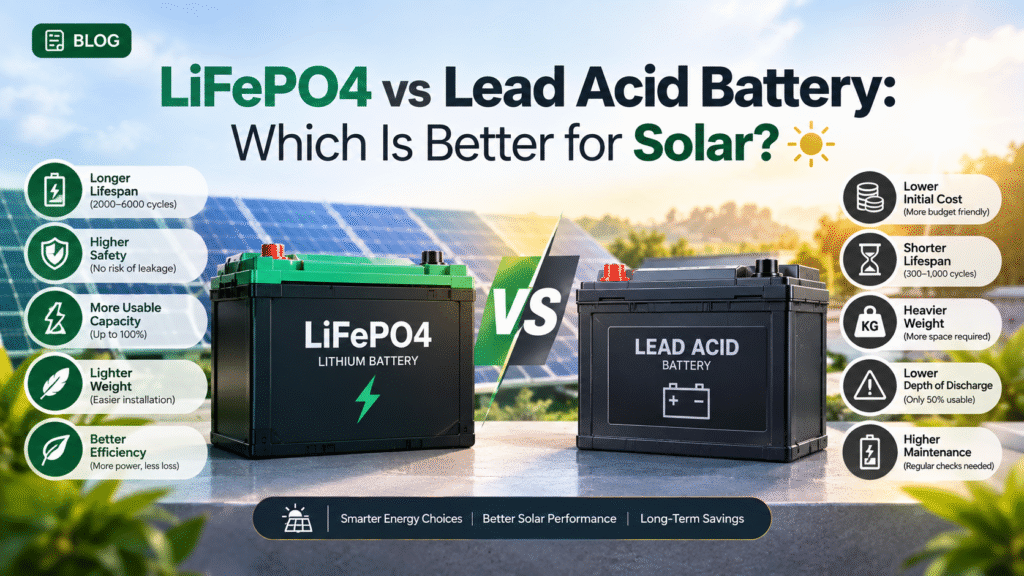
LiFePO4 (Lithium Iron Phosphate)
and
Lead Acid Batteries
So, which one is better for solar?
The answer depends on your budget, energy requirements, backup duration, available space and expected usage. However, for many modern solar energy-storage applications, LiFePO4 batteries offer significant advantages in usable capacity, charging performance, maintenance and expected cycle life.
Mainline Digital offers different battery solutions for residential, commercial and industrial applications, including lithium batteries and lead-acid/dry battery products. You can explore the company’s Lithium Batteries collection and DONGJIN battery range.
What Is a LiFePO4 Battery?
LiFePO4 stands for Lithium Iron Phosphate.
It is a type of lithium battery chemistry widely used for energy storage because of its combination of safety, durability and performance.
LiFePO4 batteries are commonly used for:
- Solar energy storage
- Home backup systems
- Hybrid solar systems
- Commercial energy storage
- UPS applications
- Off-grid systems
- Renewable energy projects
Mainline Digital offers several lithium energy-storage solutions, including products from Luminey, MENRED ESS and LIVOLTEK.
For example, the company’s MENRED LiFePO4 battery range includes multiple capacities and is designed for energy-storage applications. (mainlinedigital.com.pk)
You can explore the MENRED ESS battery range.
What Is a Lead Acid Battery?
Lead acid batteries are one of the older and widely established rechargeable battery technologies.
They have traditionally been used in:
- UPS systems
- Backup power
- Telecom applications
- Solar systems
- Emergency power systems
- Automotive applications
Mainline Digital offers DONGJIN dry batteries, including models with different voltage and capacity options.
For example, the DONGJIN DJ12-70 is a 12V 70Ah battery using absorbent glass mat technology, while the DJ12-150 is a 12V 150Ah model.
You can view the DONGJIN Battery range.
LiFePO4 vs Lead Acid: Quick Comparison
| Feature | LiFePO4 Battery | Lead Acid Battery |
|---|---|---|
| Battery Chemistry | Lithium Iron Phosphate | Lead Acid |
| Usable Capacity | Generally higher | Generally lower |
| Cycle Life | Generally much higher | Generally lower |
| Charging Speed | Faster | Slower |
| Maintenance | Low | Depends on battery type |
| Weight | Lighter | Heavier |
| Space | More compact | Larger for equivalent usable energy |
| Efficiency | Generally higher | Generally lower |
| Initial Cost | Higher | Usually lower |
| Long-Term Value | Often better | Depends on application |
| Solar Storage | Excellent | Suitable for some applications |
| BMS | Integrated in lithium systems | Different protection/charging approach |
Important: Actual performance varies by battery model, manufacturer, operating conditions and system design.
1. Battery Lifespan
One of the biggest differences between LiFePO4 and lead acid batteries is expected cycle life.
A battery is repeatedly charged and discharged in a solar system. This makes cycle life particularly important.
A quality LiFePO4 battery can be designed for thousands of charge-discharge cycles.
For example, Mainline Digital’s MENRED LiFePO4 battery specification lists a cycle life of more than 6,000 cycles under its stated test conditions. (mainlinedigital.com.pk)
Lead acid batteries can also provide useful service, but their cycle life depends heavily on battery type, depth of discharge, temperature, charging method and usage pattern.
Winner for cycle-life potential: LiFePO4
2. Usable Battery Capacity
Not all of a battery’s nominal capacity should necessarily be treated as usable energy.
For example, a battery may be advertised based on its total rated capacity, but the recommended usable portion depends on the technology and manufacturer’s specifications.
LiFePO4 systems are generally well suited to applications where a large portion of the stored energy needs to be used regularly.
This is particularly useful for solar systems where the battery may charge during the day and discharge every evening.
Winner for modern solar storage: LiFePO4
3. Charging Speed
Charging speed can be important for solar systems.
A battery may have only a limited period during the day when sufficient solar energy is available for charging.
LiFePO4 batteries generally support efficient charging and can be well suited to systems where fast energy recovery is important.
Lead acid batteries can also be charged effectively when correctly configured, but charging characteristics differ and the system must be designed according to the battery manufacturer’s specifications.
Advantage: LiFePO4
4. Weight and Size
Lead acid batteries are generally heavier for a comparable amount of usable energy.
LiFePO4 batteries can provide a more compact energy-storage solution.
This can be especially useful for:
- Homes
- Offices
- Apartments
- Shops
- Small commercial installations
- Wall-mounted battery systems
For example, Mainline Digital’s LIVOLTEK Low-Voltage Residential Battery is designed as a wall-mounted residential energy-storage solution.
The product information includes LiFePO4 chemistry, a 51.2V 100Ah configuration, intelligent BMS and IP65 protection. (mainlinedigital.com.pk)
Winner for compact installations: LiFePO4
5. Maintenance
One of the reasons lithium batteries have become popular for modern solar systems is their relatively low maintenance requirements.
A properly designed LiFePO4 battery system generally does not require the same type of routine maintenance associated with some traditional battery technologies.
However, all batteries still require:
- Correct installation
- Appropriate charging
- Suitable operating temperature
- Proper protection
- Regular system monitoring
Lead acid battery maintenance requirements depend heavily on the specific battery technology.
Advantage: LiFePO4
6. Battery Management System
Modern lithium battery systems normally use a Battery Management System (BMS).
The BMS monitors and manages battery operation and can provide protection functions related to:
- Voltage
- Current
- Temperature
- Charging
- Discharging
- Cell protection
- System safety
For example, the LIVOLTEK residential lithium battery listed by Mainline Digital features an intelligent BMS and multiple protection functions. (mainlinedigital.com.pk)
This makes the BMS an important consideration when comparing different lithium battery models.
7. Efficiency
Battery efficiency affects how much of the energy stored in a battery can actually be used by your system.
Higher efficiency can be particularly valuable in solar installations because energy may be:
Solar Panels → Inverter → Battery → Inverter → Loads
Every conversion and storage stage can involve losses.
LiFePO4 systems are generally well suited to repeated solar charging and discharging because of their efficient energy-storage characteristics.
Advantage: LiFePO4
8. Initial Purchase Price
This is where lead acid batteries often have an advantage.
A lead acid battery may have a lower upfront purchase price compared with a lithium battery of similar nominal capacity.
This can make lead acid attractive when:
- Initial budget is limited
- Battery usage is relatively low
- Backup requirements are simple
- The system is temporary
- The application does not require frequent cycling
However, initial purchase price is not the same as total cost of ownership.
A battery that costs less initially but needs to be replaced more frequently may not necessarily be cheaper over the entire life of the solar system.
Winner for lower upfront cost: Lead Acid
9. Long-Term Value
When comparing batteries, look beyond the initial purchase price.
Consider:
Purchase Price + Usable Capacity + Cycle Life + Efficiency + Maintenance + Replacement Cost
A LiFePO4 battery can cost more initially, but its longer expected cycle life and other performance characteristics may provide better long-term value for applications involving frequent cycling.
For solar systems where the battery is charged and discharged almost every day, this becomes especially important.
Potential long-term advantage: LiFePO4
10. Solar Backup Performance
A solar battery needs to handle repeated charging and discharging.
For example:
During the Day
Solar Panels → Inverter → Home Loads + Battery Charging
At Night
Battery → Inverter → Home Loads
During a Power Outage
Battery → Inverter → Backup Loads
Because solar storage can involve frequent cycling, LiFePO4 technology can be particularly attractive for modern residential and commercial systems.
LiFePO4 vs Lead Acid for Home Solar
For a home solar system, LiFePO4 can be an excellent choice when the customer wants:
- Regular daily battery cycling
- Longer expected service life
- Compact installation
- Low maintenance
- Better usable energy
- Modern battery monitoring
- Integration with a compatible hybrid inverter
Lead acid may still make sense when the primary priority is:
- Lower initial investment
- Basic backup
- Less frequent battery cycling
- Existing lead-acid infrastructure
The correct choice depends on the individual home’s energy requirements.
LiFePO4 vs Lead Acid for Commercial Solar
Commercial applications often require reliable energy storage and frequent cycling.
Businesses may use batteries for:
- Backup power
- Solar energy storage
- Load management
- Critical equipment
- Offices
- Shops
- Clinics
- Warehouses
- Industrial facilities
For these applications, battery lifespan, usable capacity, charging performance and system efficiency become increasingly important.
Mainline Digital provides energy solutions for residential, commercial and industrial applications. You can explore the company’s complete product range.
Which Battery Is Better for Solar?
So, LiFePO4 vs Lead Acid — which one should you choose?
Choose LiFePO4 if you want:
- Longer cycle life
- Frequent daily cycling
- Higher usable energy
- Faster charging
- Compact installation
- Low maintenance
- Modern BMS technology
- Long-term solar energy storage
Consider Lead Acid if you want:
- Lower upfront investment
- Basic backup power
- Less frequent cycling
- A simple and established battery technology
- Compatibility with an existing system
For a modern solar installation where the battery will be used frequently, LiFePO4 is generally the stronger choice.
How to Choose the Right LiFePO4 Battery
If you decide to go with lithium, don’t choose a battery based only on its kWh rating.
Check:
1. Capacity
How many kWh do you need?
2. Voltage
Does it match your inverter?
3. Usable Energy
How much energy can actually be used?
4. Cycle Life
How many cycles does the manufacturer specify?
5. BMS
What protection and monitoring features are included?
6. Communication
Does it support your inverter’s required communication protocol?
7. Warranty
What warranty does the manufacturer provide?
8. Installation
Does the quoted price include installation and configuration?
Why Inverter Compatibility Matters
Even the best lithium battery may not perform correctly if it is not compatible with the inverter.
Before purchasing a battery, check:
- Battery voltage
- Inverter voltage
- Maximum charging current
- Maximum discharge current
- CAN communication
- RS485 communication
- Supported battery protocols
- Firmware requirements
- Recommended battery models
Mainline Digital offers a dedicated Solar Inverters range, including brands such as Solis, Luminey, Inverex, LIVOLTEK and HWOO.
A properly matched solar panel + inverter + battery combination is essential for reliable performance.
Does LiFePO4 Cost More Than Lead Acid?
Usually, the initial purchase price of a LiFePO4 battery is higher than a comparable lead-acid solution.
But this doesn’t automatically mean LiFePO4 is more expensive over its useful life.
A proper comparison should consider:
Initial Cost
↓
Usable Capacity
↓
Cycle Life
↓
Efficiency
↓
Maintenance
↓
Replacement Requirements
↓
Total Cost of Ownership
This is a much better way to compare the two technologies.
LiFePO4 vs Lead Acid: Final Verdict
For modern solar energy storage, LiFePO4 batteries offer several important advantages over traditional lead-acid batteries, particularly for applications requiring frequent cycling.
| Category | Better Option |
|---|---|
| Initial Cost | Lead Acid |
| Cycle Life | LiFePO4 |
| Usable Energy | LiFePO4 |
| Charging Performance | LiFePO4 |
| Weight | LiFePO4 |
| Space Efficiency | LiFePO4 |
| Maintenance | LiFePO4 |
| Modern Solar Storage | LiFePO4 |
| Long-Term Value | Often LiFePO4 |
| Basic Low-Cost Backup | Lead Acid |
The best choice ultimately depends on your budget, solar system, inverter, backup requirements and expected battery usage.
If you’re installing a new solar system and expect to charge and discharge the battery regularly, LiFePO4 is generally the better technology to consider.
Explore Battery Solutions from Mainline Digital
Mainline Digital provides solar and energy-storage solutions for residential, commercial and industrial applications.
You can explore:
Lithium Batteries – Lithium energy-storage solutions
Luminey Batteries – Residential and commercial lithium solutions
MENRED ESS – LiFePO4 energy-storage solutions
LIVOLTEK Lithium Batteries – Residential lithium battery solutions
DONGJIN Batteries – Dry battery solutions
Solar Inverters – Compatible solar inverter solutions
All Products – Explore Mainline Digital’s complete product range
Frequently Asked Questions
Is LiFePO4 better than lead acid for solar?
For many modern solar applications, yes. LiFePO4 generally offers advantages in cycle life, usable energy, charging performance, weight and maintenance. However, lead acid can still be suitable for lower-cost or less frequently cycled applications.
Is LiFePO4 more expensive than lead acid?
LiFePO4 normally has a higher initial purchase price, but its longer cycle life and other performance advantages can make it more economical over the long term.
How long does a LiFePO4 solar battery last?
The lifespan depends on the battery model, usage, depth of discharge, temperature and charging conditions. Always check the manufacturer’s cycle-life specification and warranty.
Can I replace my lead acid battery with LiFePO4?
Not always directly. The inverter/charger must support the lithium battery’s voltage, charging requirements and communication system. Professional compatibility checking is recommended.
Is LiFePO4 safe for home solar?
LiFePO4 is widely used for energy storage, but correct installation, battery management, protection and operating conditions are still essential.
Which battery is better for daily solar use?
For systems that regularly charge and discharge every day, LiFePO4 is generally a strong choice because of its cycle-life and performance characteristics.
Which battery is cheaper?
Lead acid generally has the lower upfront purchase cost, while LiFePO4 may provide better long-term value depending on how frequently the battery is used.
Final Conclusion
The choice between LiFePO4 vs Lead Acid Battery should not be based on price alone.
If your priority is long-term solar energy storage, frequent cycling, higher usable capacity, low maintenance and modern battery technology, LiFePO4 is generally the better option.
If your priority is lower initial cost and basic backup power, lead acid may still be appropriate for certain applications.
The most important step is to select the battery according to your solar system, inverter, load requirements and backup needs.
For professional guidance and a suitable battery solution, contact Mainline Digital.
Mainline Digital (Pvt.) Ltd.
19-A, Block E, Opposite Elahi Tower, PIA Housing Society, PIA Road, Lahore, Pakistan
Phone: +92 42 35 400 400
Mobile: +92 322 1444 555 | +92 321 111 7765
Email: info@mainlinedigital.com.pk