
Quick answer: The best UPS for most Pakistani homes is a line-interactive UPS, which regulates voltage fluctuations and provides reliable backup during load-shedding. Offices with sensitive equipment like servers should choose an online (double-conversion) UPS for continuous, uninterrupted power.
A UPS remains one of the most common backup power solutions in Pakistani homes and offices, especially for short outages where a full solar system isn’t necessary. But with dozens of brands and three different UPS types on the market, picking the right one comes down to understanding your actual load and backup needs.
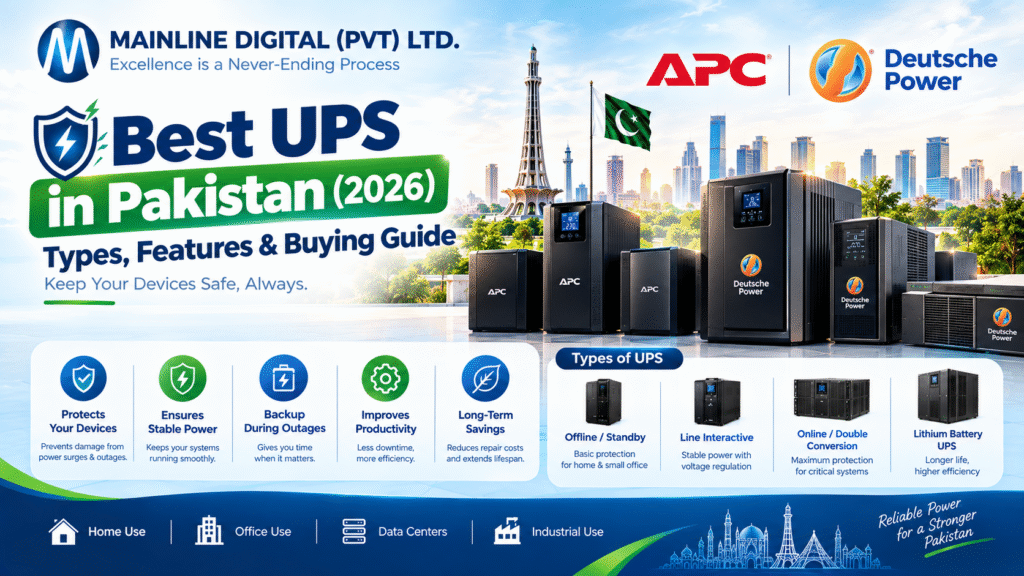
The 3 Types of UPS Available in Pakistan
Offline (Standby) UPS
The most basic type. It switches to battery power only when the grid fails, with a brief transfer delay. Suitable for basic loads like fans, lights, and routers.
Line-Interactive UPS
Offers better protection than offline units by regulating voltage fluctuations (AVR) without switching to battery, which also extends battery life. A good middle-ground choice for most homes and small offices.
Online (Double-Conversion) UPS
The highest level of protection — it continuously powers connected devices without any transfer delay, making it ideal for sensitive equipment like servers and critical business systems.
Popular UPS brands available in Pakistan include Homage, Inverex, EcoStar, Apollo, ProLink, Crown Micro, and imported options like APC.
Lead-Acid vs Lithium-Ion UPS Batteries
| Factor | Lead-Acid (SLA) | Lithium-Ion |
|---|---|---|
| Lifespan | 3-5 years | 10-15 years |
| Charging speed | Slower | Faster |
| Maintenance | Higher | Minimal |
| Weight | Heavier | Lighter |
Lithium-ion UPS batteries typically work out more economical over time since they don’t need replacement every few years like lead-acid batteries do — an important factor for Pakistan’s frequent daily cycling from load-shedding.How to Choose the Right UPS Capacity
Add up the wattage of everything you need to power during an outage — fans, lights, a router, a TV, a fridge — to get your minimum required capacity:
- 1 PC/router setup: 500-600VA
- A few fans + lights: 1000-1200VA
- Full room with TV + fridge: 1500-2000VA
- Small office/multiple rooms: 2400VA – 3000VA+
Always choose a UPS rated slightly above your calculated load to avoid overloading it during peak usage.
FAQ
Which UPS type is best for Pakistan’s frequent load-shedding?
A line-interactive UPS is the best balance for most homes, offering voltage regulation and reliable backup. Offices with sensitive equipment should consider an online (double-conversion) UPS.
Is a lithium-ion UPS battery worth it in Pakistan?
Yes, for most users. Lithium-ion lasts 10-15 years versus 3-5 years for lead-acid, which makes it more economical overall given how often Pakistani UPS batteries cycle due to load-shedding.
How long does a UPS last during a power outage?
This depends entirely on battery capacity and connected load — a basic UPS might last 15-30 minutes under full load, while a UPS paired with a larger battery bank can run for several hours.
Can a UPS work with solar panels in Pakistan?
Standard UPS units aren’t designed for solar charging input. If you want solar-compatible backup, a hybrid solar inverter (sometimes called a “solar UPS”) is the purpose-built solution rather than modifying a traditional UPS.
What size UPS do I need for my home?
Add up the wattage of everything you want to run during an outage — for a full room with a TV and fridge, look for a UPS in the 1500-2000VA range, and for a small office, 2400VA or higher.